
The Testosterone Crash After 40: Why Men Lose Their Edge

Testosterone crash after 40 is the single most common — and most silently destructive — hormonal event in a man’s life.
And most men never see it coming until it has already cost them their confidence, their performance, their energy, and in many cases their relationship.
Here is the reality that most men over 40 are living but not talking about.
The drive that used to be automatic is gone.
The performance that used to be effortless now requires effort — and sometimes does not show up at all.
The energy that carried you through demanding days has been replaced by a fatigue that sleep does not fix.
The confidence that used to feel natural has given way to self-doubt and anxiety that you cannot explain.
And like millions of other men you are probably telling yourself the same thing.
Testosterone Crash After 40
This is just getting older.
This is normal.
There is nothing I can do about it.
That is not true.
And understanding why requires understanding what testosterone actually does — and what happens to a man when it crashes.
What Is Testosterone And Why Does It Matter?
Testosterone is not just a sex hormone.
It is the primary driver of what makes a man a man — physically, sexually, and psychologically.
It controls libido, sexual function, erection quality, stamina, and recovery.
It drives muscle growth, fat metabolism, bone density, and cardiovascular health.
It regulates mood, confidence, motivation, drive, and the sense of mental sharpness and decisiveness that healthy men experience.
Testosterone Crash After 40
When testosterone is optimal, everything works.
Energy is high.
Drive is strong.
Performance in every area of life — from the bedroom to the boardroom — feels natural and effortless.
You feel like yourself at your best.
When testosterone crashes, everything suffers.
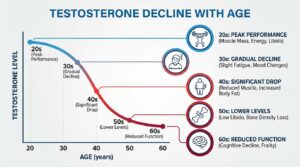
And because the decline is gradual
— dropping by approximately 1 percent every year after age 30
— most men do not notice the problem until it has already progressed to a point where the consequences are impossible to ignore.
How Testosterone Crashes: The Biological Reality
After age 40 the testosterone crash accelerates.
Several biological mechanisms drive this decline simultaneously.
The hypothalamic-pituitary axis
— the hormonal communication system that signals the testes to produce testosterone
— becomes less efficient with age.
The testes themselves produce less testosterone in response to those signals.
At the same time levels of sex hormone-binding globulin increase — binding to the testosterone that is produced and making it unavailable for the body to use.
The result is a double attack on testosterone.
Testosterone Crash After 40
Less is produced and less of what is produced is free and available.
Meanwhile cortisol — the stress hormone — rises with the chronic stress that accumulates through career, family, and financial pressures in midlife.
Cortisol is directly antagonistic to testosterone.
The higher cortisol rises the more it suppresses testosterone production.
This is why men who are under sustained stress often experience the most dramatic and rapid testosterone crashes.
Poor sleep — which becomes more common with age — further suppresses testosterone.
The majority of testosterone production occurs during deep sleep.
When sleep quality declines testosterone production declines with it.
And excess body fat — particularly the visceral fat that accumulates around the midsection as men age — actively converts testosterone to estrogen through a process called aromatization.
The more belly fat a man carries the more his testosterone is being converted to estrogen — accelerating the crash and creating a vicious cycle that becomes increasingly difficult to break.
The Devastating Consequences of Low Testosterone
Most men think low testosterone is just about sex drive.
That is a dangerous oversimplification.
Low testosterone affects every system in the male body.
And the consequences compound over time in ways that go far beyond the bedroom.
Sexual Performance Decline
Testosterone Crash After 40
This is the consequence men notice first and feel most acutely.
Libido fades.
Erections become less reliable, less firm, and harder to maintain.
Recovery time between encounters lengthens dramatically.
The spontaneous desire and effortless performance that characterized younger years feels like a distant memory.
The psychological impact of sexual performance decline is severe.
Confidence erodes.
Anxiety about performance begins to interfere with performance itself — creating a self-reinforcing cycle where anxiety suppresses the testosterone and nitric oxide production that healthy erection function depends on.
Relationship Damage
The connection between male sexual performance and relationship health is well documented.
Research consistently shows that sexual dissatisfaction is one of the primary drivers of relationship tension, emotional distance, and infidelity.
When a man cannot perform reliably, when his libido is low and his partner’s is not, when intimacy becomes a source of anxiety rather than connection — the relationship suffers.
Communication deteriorates.
Emotional distance increases.
The intimacy that sustains long-term relationships begins to erode.
Physical Decline
Low testosterone drives a significant deterioration in body composition. Muscle mass decreases as testosterone — the primary anabolic hormone — declines.
Fat storage increases, particularly visceral abdominal fat.
Bone density declines over time.
Physical strength and endurance decrease.
The man who used to maintain his physique without excessive effort finds himself gaining weight and losing muscle despite not significantly changing his diet or activity level.
This body composition change is a direct consequence of testosterone decline — not simply a result of aging or lifestyle choices.
Mental and Emotional Deterioration
Testosterone Crash After 40
The psychological consequences of testosterone crash are often the most debilitating and the least recognized.
Low testosterone is directly associated with depression, anxiety, irritability, and a loss of the motivation and drive that healthy testosterone levels support.
Men with low testosterone frequently describe a flatness — a loss of the ambition, competitive drive, and sense of purpose that characterized their younger years.
They feel less decisive. Less confident.
Less engaged.
The mental edge that testosterone provides when it is optimal simply disappears.
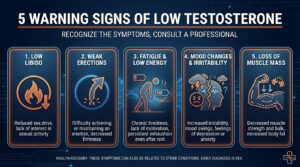
The 5 Warning Signs Your Testosterone Has Already Crashed
Because testosterone decline is so gradual most men minimize the early warning signs for years.
Here are the five signs that your testosterone has already dropped to concerning levels:
- Your Libido Has Significantly Decreased
If your desire for sex has declined noticeably from what it was in your 30s — if days or weeks go by without interest — low testosterone is almost certainly a factor.
Testosterone is the primary driver of male libido. When it drops libido drops with it.
- Your Erections Are Weaker, Less Reliable, or Less Frequent
If achieving a firm erection requires more effort than it used to, if erections are less rigid than before, or if maintaining an erection through an entire encounter has become challenging, your testosterone and nitric oxide levels have declined.
Testosterone Crash After 40
This is one of the most telling and most impactful signs of testosterone crash.
- You Are Chronically Fatigued Despite Adequate Sleep
If you are sleeping but not recovering — if you wake up tired and drag yourself through the day — low testosterone is likely contributing. Testosterone is essential for energy production and physical recovery. When it crashes chronic fatigue follows.
- Your Mood Has Changed — More Irritable, Anxious, or Unmotivated
If you are more easily frustrated, more anxious, less motivated, or have lost the competitive drive and sense of purpose you used to have — these are direct psychological consequences of testosterone decline. Testosterone has profound effects on mood, confidence, and mental drive.
- You Are Gaining Fat and Losing Muscle Despite Your Efforts
If your body composition is changing in ways that diet and exercise are not fixing — belly fat accumulating, muscle tone declining — low testosterone is driving those changes.
As testosterone falls the body shifts toward fat storage and away from muscle maintenance.
Why Most Men Never Get Help — And Pay the Price
Research shows that the vast majority of men experiencing low testosterone symptoms never seek help.
Several barriers prevent them from acting.
First, the gradual nature of the decline makes it easy to rationalize.
Because it happens slowly over years men adapt to each incremental step down and tell themselves they are fine.
By the time the decline is undeniable significant damage has often been done.
Testosterone Crash After 40
Second, there is genuine embarrassment and stigma around discussing sexual performance issues.
Men are socialized not to admit vulnerability in this area. So they suffer in silence while the consequences for their health, confidence, and relationships compound.
Third, many men assume the only solution is prescription testosterone replacement therapy — which carries real risks including cardiovascular effects, fertility suppression, and hormonal dependency.
They are not wrong to be cautious about prescription RagnarX.
But they are wrong if they believe prescription therapy is the only option.
Natural testosterone support
— using the specific botanical compounds, amino acids, and adaptogens that clinical research has shown to support healthy testosterone production, reduce the cortisol that suppresses it,
and boost the nitric oxide that sexual performance depends on — offers a meaningful alternative for men with age-related testosterone decline.
What Actually Works to Restore Testosterone Naturally
The most effective natural approach to testosterone support addresses the three primary drivers of low testosterone simultaneously.
Supporting the body’s own testosterone production through ingredients like Tribulus Terrestris and Maca Root that have been shown to enhance androgen receptor sensitivity and support healthy hormonal balance.
Reducing the cortisol that suppresses testosterone through adaptogens like Ashwagandha that calm the stress response and protect testosterone production from cortisol interference.
Boosting nitric oxide for sexual performance through compounds like L-Arginine and Horny Goat Weed that support healthy blood flow
— the physical mechanism that erection quality and sexual stamina depend on.
When these three mechanisms are targeted simultaneously the results are dramatically more powerful than addressing any single factor alone.
The Bottom Line: Your Testosterone Is Not Coming Back On Its Own
The testosterone crash that most men over 40 are experiencing is real, progressive, and consequential.
Testosterone Crash After 40
It is not just about sex.
It is about energy, confidence, mood, body composition, and the fundamental experience of being a healthy, vital man.
The good news is that natural testosterone support works — and it works without the risks and dependency of prescription hormone therapy.
“That’s why more men over 40 are looking for natural ways to support their testosterone levels…
Instead of extreme diets or risky treatments, many are turning to simple daily solutions.
Recently, one option that’s been getting attention is a formula known as RagnarX.
It’s designed to support male performance, energy, and hormonal balance — especially for men dealing with that gradual decline after 40.
While it’s not an overnight fix, many users report feeling more energized, focused, and confident over time.”
Click here to read the full RagnarX Gummies and discover the natural solution to testosterone crash
Do not spend another year accepting low energy, diminished performance, and relationship tension as your new normal.
Your testosterone — and everything that depends on it — is worth fighting for.
Disclaimer: This article is for informational and educational purposes only. It is not intended to diagnose, treat, cure, or prevent any disease. Always consult with a qualified healthcare professional before starting any new supplement.
Leave a Reply