
Sciatic Nerve Pain After 50: The Real Cause Doctors Miss

Sciatic nerve pain after 50 is one of the most debilitating and life-limiting conditions affecting older adults in the United States today.
That burning, shooting, electric-shock pain that radiates from your lower back through your buttock and down your leg is not just a nuisance.
It is a signal that your body is sending you — a signal that most conventional treatments completely ignore.
Over 40 million Americans are currently living with some degree of sciatic nerve pain.
Sciatic Nerve Pain After 50
And the vast majority of them are being told by their doctors to take painkillers, get injections, or consider surgery.
They follow this advice. And the pain keeps coming back.
Because the treatments are not addressing the real problem.
In this article you are going to discover exactly what the sciatic nerve is and why it hurts so badly when it is damaged, the real root cause of sciatic pain that conventional medicine consistently misses, why painkillers, injections, and surgery fail to provide lasting relief, the five warning signs that your sciatic nerve is already damaged, and what the latest research shows actually works to repair nerve damage and restore lasting pain relief.
What Is the Sciatic Nerve and Why Does Sciatica Hurt So Much?
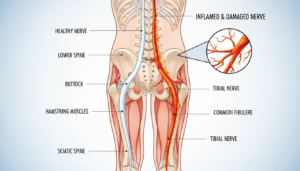
The sciatic nerve is the longest and thickest nerve in the human body.
It originates in the lower spine, passes through the buttock, and runs down the entire length of the leg all the way to the foot.
On each side of the body this nerve is responsible for sensation and movement throughout the lower extremity.
When the sciatic nerve is healthy and undamaged it functions silently — transmitting signals between your brain and your lower body without you being aware of it.
But when it becomes compressed, inflamed, or damaged the experience is anything but silent.
Damaged nerve tissue behaves like a frayed electrical wire.
It fires off random, erratic pain signals — sending jolts, burning sensations, tingling, and electric-shock-like pain shooting down the leg at unpredictable moments.
Sitting becomes painful.
Sciatic Nerve Pain After 50
Standing up from a chair triggers a shock of agony.
Lying down offers no relief.
Even sleeping becomes impossible as the nerve fires through the night.
This is what millions of adults over 50 are living with every single day.
And most of them have been told there is little that can be done beyond managing the pain with medications.
That is not true. And understanding why requires understanding what is actually causing the damage.
The Real Root Cause of Sciatic Pain That Most Doctors Miss
Here is what conventional medicine consistently gets wrong about sciatica.
The conversation almost always focuses on structural causes — a herniated disc pressing on the nerve, bone spurs, spinal stenosis.
And while these structural factors can contribute to sciatic compression, they are often not the primary driver of the nerve damage that causes the most persistent and severe pain.
The real root cause — the one that explains why so many people continue suffering even after structural issues are addressed — is this: damaged, nutrient-starved nerve tissue.
Sciatic Nerve Pain After 50
Your sciatic nerve, like every nerve in your body, requires a constant supply of specific vitamins, minerals, and antioxidants to maintain its protective myelin sheath
— the insulating layer that surrounds nerve fibers and allows them to transmit signals properly.
It requires these nutrients to repair damage as it occurs.
It requires them to manage inflammation and protect nerve cells from oxidative stress.
When these critical nutrients are deficient
— which becomes increasingly common with age as absorption decreases and dietary gaps accumulate
— the myelin sheath degrades.
The nerve becomes more vulnerable to damage and inflammation.
Repair mechanisms slow down.
And the result is a nerve that is increasingly sensitive, increasingly painful, and increasingly unable to heal.
This is why painkillers and injections do not work long-term.
They mask the pain signal but they do nothing to restore the nutrient supply the nerve needs to repair itself.
The damage continues underneath the temporary relief.
And when the medication or injection wears off the pain returns — often worse than before.
Why Conventional Treatments Fail to Fix the Real Problem
Let us be direct about what the most common sciatica treatments actually do — and what they do not do.
Painkillers mask the pain signal while the nerve continues to degrade beneath the surface.
They do not reduce inflammation at the nerve level.
They do not support nerve repair.
They do not address nutrient deficiency.
And long-term use carries serious risks including dependency, gastrointestinal damage, and cardiovascular effects.
Epidural steroid injections provide temporary relief for some patients — sometimes weeks, sometimes months.
But the steroid addresses inflammation locally and temporarily.
Sciatic Nerve Pain After 50
It does not repair the damaged nerve tissue.
It does not restore the nutrient environment the nerve needs to heal.
When the injection wears off the underlying damage has not changed and the pain returns.
Surgery is recommended for a relatively small percentage of sciatica patients — and the outcomes are mixed.
Many patients experience significant improvement.
But many others continue to have symptoms after surgery.
And all surgery carries risks including infection, nerve damage, and failed back surgery syndrome.
Surgery can address structural compression but it cannot repair the nerve tissue damage that nutrient deficiency has caused.
Physical therapy can help strengthen the muscles that support the spine and reduce compression on the sciatic nerve.
For some patients it provides meaningful relief.
But for others the exercises themselves trigger pain flare-ups.
And like surgery and injections, physical therapy does not address the nutritional environment of the nerve itself.
The pattern is consistent.
Treatments that target only the structural or symptomatic aspects of sciatica while ignoring the biological repair needs of the nerve itself provide incomplete and often temporary results.
The 5 Warning Signs Your Sciatic Nerve Is Already Damaged
Because sciatic nerve damage develops gradually, many people dismiss the early signs as temporary muscle soreness or strain.
Here are the five warning signs that the damage has already progressed to a point requiring intervention:
1.Burning or Electric Shock Pain Shooting Down Your Leg
The signature symptom of sciatic nerve damage is a shooting pain that travels from the lower back or buttock down through the leg — sometimes reaching the foot.
This pain often feels like an electric shock or burning sensation rather than the dull ache of muscle soreness.
If you are experiencing this you are dealing with nerve pain not muscle pain.
2.Tingling or Numbness in Your Leg, Calf, or Foot
Tingling — the pins and needles sensation — and numbness in the lower extremity are signs that the sciatic nerve is not transmitting signals properly.
This happens when the nerve’s myelin sheath is damaged and signal transmission becomes erratic and unreliable.
3.Pain That Is Worse When Sitting or Standing for Extended Periods
The sciatic nerve experiences increased pressure when the body is in certain positions — particularly seated or standing for extended periods.
Sciatic Nerve Pain After 50
If your pain consistently worsens after sitting or causes you to shift positions constantly seeking relief your sciatic nerve is already significantly compromised.
4.Pain That Wakes You From Sleep
If sciatic nerve pain is interrupting your sleep
— waking you with shooting or burning sensations through the night
— the damage has progressed to a level where the nerve is firing continuously rather than only under physical stress.
This level of pain has serious consequences for sleep quality, immune function, mood, and healing.
5.Pain That Has Made You Limit Your Activities
If sciatic nerve pain has caused you to stop doing things you used to enjoy
— avoiding outings, declining invitations, skipping family gatherings, giving up exercise or hobbies
— because the fear of triggering pain is controlling your decisions, the quality of life impact is severe and the situation requires urgent attention.

What the Research Actually Shows Works
The good news is that targeted nutritional support for the sciatic nerve
— providing the specific vitamins, minerals, and antioxidants that nerve repair and protection require
— has been shown in clinical research to produce meaningful and lasting relief that conventional treatments cannot match.
Here is what the research identifies as most critical for sciatic nerve health and repair.
Vitamin B12 and B6 are essential for the health and integrity of the myelin sheath that protects nerve fibers.
Sciatic Nerve Pain After 50
Deficiency in either of these B vitamins is directly linked to nerve damage, increased pain sensitivity, and impaired nerve repair.
Clinical studies have shown that B12 supplementation significantly reduces nerve pain and supports myelin regeneration.
Alpha Lipoic Acid is one of the most powerful antioxidants available for nerve protection.
Research has consistently shown it reduces tingling, numbness, and burning pain associated with nerve damage
— with multiple clinical trials demonstrating significant pain reduction and improved nerve function.
Magnesium relaxes muscles that can compress the sciatic nerve while also reducing neuroinflammation at the nerve level.
Magnesium deficiency
— which affects a large percentage of older adults
— is directly associated with increased nerve pain sensitivity and muscle spasm.
Bacopa Monnieri has been shown to calm nerve pain, reduce neuroinflammation, and support nerve regeneration
— making it one of the most valuable botanicals for addressing sciatic nerve damage from the inside out.
N-Acetyl L-Cysteine is a powerful antioxidant that protects nerves from oxidative damage, reduces inflammation, and has been specifically shown to ease disc-related nerve pain.
When these nutrients and compounds are delivered together in therapeutic doses the results go far beyond what any single ingredient alone can achieve.
The nerve repair mechanisms are activated from multiple directions simultaneously
— reducing inflammation, protecting myelin, supporting regeneration, and calming the erratic pain signals that damaged nerve tissue produces.
The Bottom Line: Your Sciatic Nerve Can Heal — But Not With Painkillers
If you have been living with sciatic nerve pain and relying on painkillers, injections, or repeated trips to physical therapy without lasting results — the problem is not that nothing can help you.
The problem is that the treatments you have been using are not addressing the root cause.
Sciatic Nerve Pain After 50
Your sciatic nerve is damaged and nutrient-starved.
Until those nutrients are restored and the repair process is supported from the inside out the pain will keep coming back.
That is not a pessimistic statement. It is the logical consequence of treating symptoms while ignoring the underlying biology.
The encouraging reality is that nerve tissue can repair itself when given what it needs.
The research is clear.
The right combination of targeted nutritional support can reduce inflammation, restore myelin integrity, calm the nerve signals that cause pain, and support the regeneration that allows lasting relief.
If you’ve been dealing with persistent discomfort, especially the kind described in Sciatic Nerve Pain After 50: The Real Cause Doctors Miss, it may be a sign that your body needs more than temporary relief.
This type of deep, radiating pain is often linked to underlying nerve issues that are frequently overlooked.
Instead of just masking the symptoms, supporting your nerve health directly can make a real difference over time.
That’s why many people are turning to natural solutions like NervEase, designed to help target the root of nerve discomfort and promote long-term relief.
If you’re ready to take a smarter step toward feeling better, you can learn more about how it works below.
Click here to read the full NervEase Back Pain and Sciatica and discover the natural approach to lasting sciatic nerve relief
Do not spend another year managing pain instead of healing it. Your sciatic nerve can repair itself. It just needs the right support.
Disclaimer: This article is for informational and educational purposes only. It is not intended to diagnose, treat, cure, or prevent any disease. Always consult with a qualified healthcare professional before starting any new supplement or changing your treatment approach.
Leave a Reply