
Nerve Pain Relief: Causes, Symptoms, and Natural Ways to Reduce Pain in Feet and Hands

Nerve pain relief is something millions of people search for only after the symptoms have already begun disrupting their daily lives.
What starts as a mild tingling in the fingers or an occasional burning sensation in the feet can quietly develop into a persistent, life-altering condition that touches everything — sleep, mobility, concentration, and emotional wellbeing.
The problem is that most people wait too long.
By the time they actively seek nerve pain relief, the underlying damage has often been building for months — sometimes years.
And because nerve pain feels fundamentally different from muscle soreness or joint stiffness, many people struggle to identify it, describe it to their doctors, or find treatments that actually address the root cause rather than just numbing the surface.
This article breaks down exactly what nerve pain is, why it develops, what the warning signs look like at every stage, and what approaches are showing the most promise for real, lasting relief.
What Is Nerve Pain — And Why Does It Feel So Different?
Nerve pain — clinically referred to as neuropathic pain or neuropathy — is pain that originates from damaged, compressed,
or dysfunctional nerves rather than from injured tissue, muscles, or joints.
This distinction matters enormously, because it explains why standard pain management approaches so often fail people with nerve conditions.
When nerves are damaged, they begin to misfire.
Instead of accurately transmitting signals between the brain and the body, they send distorted, exaggerated, or completely false pain signals.
The brain receives these signals and responds as if the body is in danger — even when there is no visible injury.
This is why nerve pain can feel so confusing and difficult to treat.
It may burn when nothing is hot.
It may cause sharp electric shocks with no apparent trigger.
It may make a light touch feel agonizing.
Or it may remove all sensation entirely, creating dangerous numbness that makes it impossible to detect real injuries.
The most commonly affected areas are the hands and feet — the extremities that are farthest from the brain and spinal cord, and therefore the most vulnerable to disruptions in nerve signaling and blood supply.
The Most Common Causes of Nerve Pain in Feet and Hands
Understanding what is causing nerve pain is the foundation of finding effective nerve pain relief.
These are the most clinically significant drivers:
High Blood Sugar and Diabetic Neuropathy
The most widespread cause of peripheral neuropathy worldwide is prolonged high blood sugar.
When glucose levels remain elevated over time, the small blood vessels that supply oxygen and nutrients to nerve fibers begin to deteriorate.
Starved of their blood supply, nerve fibers progressively lose their ability to function and repair themselves.
This condition — diabetic peripheral neuropathy — affects an estimated 50% of people with diabetes over time.
But what many people don’t realize is that nerve damage can begin years before a formal diabetes diagnosis, during the pre-diabetic phase when blood sugar is already elevated but not yet flagged as critical.
This means that millions of people experiencing tingling, burning, or numbness in their feet and hands may have blood sugar-driven nerve damage — without knowing it.
Poor Circulation and Vascular Disease
Nerves require a constant, rich supply of oxygenated blood to function.
When circulation is compromised — through arterial disease, high blood pressure, sedentary lifestyle, smoking, or obesity — nerve tissue begins to suffer.
The peripheral nerves in the hands and feet are particularly vulnerable because they are at the end of the circulatory chain, receiving blood last.
Chronic poor circulation doesn’t just cause immediate nerve pain.
It also dramatically slows the nerve’s natural ability to repair and regenerate, turning what might have been a recoverable condition into a progressive one.
Chronic Inflammation
Systemic inflammation is one of the most underappreciated drivers of neuropathic pain.
When the immune system is chronically activated — due to poor diet, metabolic disease, autoimmune conditions, or environmental stress
— inflammatory compounds called cytokines can directly attack nerve tissue and the myelin sheath that protects nerve fibers.
An inflamed nerve fires pain signals more easily, more frequently, and more intensely than a healthy one.
This is why reducing inflammation is a central strategy in any serious approach to nerve pain relief.
Nutritional Deficiencies
Several vitamins and minerals play direct, essential roles in nerve health.
Deficiency in any of them can impair nerve function, slow repair processes, and worsen existing neuropathy:
Vitamin B12 is perhaps the most critical.
It is essential for maintaining the myelin sheath — the protective coating around nerve fibers that allows signals to travel efficiently.
B12 deficiency causes progressive myelin breakdown, leading to tingling, numbness, and eventually nerve damage that can become permanent if untreated.
B12 deficiency is extremely common, particularly in older adults, vegetarians, and people taking metformin for blood sugar management.
Vitamin B1 (Thiamine) supports energy production inside nerve cells.
Deficiency is associated with burning pain and weakness in the extremities.
Vitamin D receptors are present throughout the nervous system.
Low vitamin D levels are consistently associated with increased neuropathic pain sensitivity and slower nerve recovery.
Magnesium plays a key role in regulating nerve excitability.
Deficiency causes nerves to fire more easily — directly amplifying pain perception.
Alpha Lipoic Acid is a powerful antioxidant produced naturally in the body that protects nerve cells from oxidative damage.
Its levels decline with age and metabolic disease.
Spinal Compression and Nerve Entrapment
Physical compression of nerve roots
— from herniated discs, spinal stenosis, or structural changes in the spine
— can cause radiating pain, tingling, and numbness that travels into the arms, hands, legs, and feet.
Carpal tunnel syndrome, a form of nerve entrapment at the wrist, is one of the most common causes of hand and finger pain and numbness in working-age adults.
These mechanical causes are distinct from metabolic neuropathy but often coexist with it, making accurate diagnosis essential.
Early Warning Signs of Nerve Damage You Should Never Ignore
One of the most dangerous aspects of peripheral neuropathy is how gradually and quietly it develops.
The early symptoms are easy to dismiss — and most people do, until the damage has progressed significantly.
Early warning signs include:
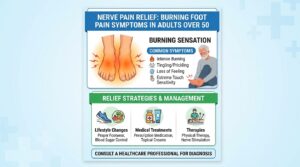
Tingling or pins-and-needles sensations in the hands or feet, especially after sitting or lying in certain positions
— but also spontaneously, without pressure on the limb.
Mild burning sensations in the soles of the feet or palms of the hands, often worse at night when there are fewer distractions.
Increased sensitivity to touch
— socks, shoes, or bed sheets that feel unusually rough or uncomfortable.
Occasional numbness or reduced sensation, particularly in the toes and fingertips.
Discomfort that comes and goes, making it easy to rationalize as temporary.
At this early stage, nerve pain relief is most achievable.
The nerves retain significant capacity for recovery when the underlying cause is addressed promptly.
This is the window when lifestyle changes, nutritional support, and targeted interventions can make the greatest difference.
When Nerve Pain Becomes Severe — Advanced Symptoms

Without intervention, peripheral neuropathy progresses.
The warning signals that were once occasional become constant.
The symptoms that were mild become debilitating.
Advanced nerve damage produces:
Persistent burning pain that does not resolve with rest or position changes
— present day and night.
Sharp, stabbing, or electric shock-like pain that comes without warning and can be triggered by the lightest touch.
Profound numbness and loss of sensation
— particularly dangerous in the feet, because injuries (cuts, blisters, pressure wounds) go undetected and can develop into serious infections.
Loss of balance and coordination, because the nerves that communicate position information from the feet to the brain are no longer functioning reliably.
Muscle weakness and wasting in the hands and feet, making gripping, walking, and fine motor tasks increasingly difficult.
Autonomic symptoms in more severe cases
— affecting heart rate, digestion, blood pressure regulation, and bladder function.
At this stage, finding nerve pain relief shifts from recovery to damage control.
The goal becomes slowing progression, managing symptoms effectively, and protecting remaining nerve function.
Some multi-ingredient formulas targeting peripheral nerve health
— like Nerve Fresh — combine several of these nutrients in a single daily formula designed specifically for tingling, burning, and numbness in the extremities.
Why Most Standard Treatments Fail to Provide Real Nerve Pain Relief
The conventional treatment landscape for neuropathic pain is frustrating for many patients.
Prescription medications
— anticonvulsants like gabapentin and pregabalin, antidepressants like duloxetine, and opioid painkillers
— can reduce the perception of pain. But they do not address the underlying nerve damage.
They do not improve circulation to nerve tissue.
They do not provide the nutrients nerves need to repair themselves.
They do not reduce the inflammation that is continuing to damage nerve fibers.
This creates the cycle that so many people with nerve pain know well:
the medication provides partial relief, the dose increases, side effects accumulate, and the underlying condition continues to progress beneath the surface.
Topical treatments
— capsaicin creams, lidocaine patches
— offer localized, temporary relief but similarly do nothing for the root biological problem.
Real, lasting nerve pain relief requires addressing what is actually happening inside the nerve tissue.
A Smarter Approach: Supporting Nerve Health From the Inside
The most promising long-term strategies for nerve pain relief focus on the biology of nerve health
— circulation, inflammation, nutrition, and nerve regeneration.
These are not quick fixes.
But they are the only approaches that address the actual problem rather than masking it.
Restore Circulation to Nerve Tissue
Improving blood flow to peripheral nerves restores the oxygen and nutrient supply that damaged nerves desperately need.
Strategies include regular physical activity
— even moderate walking significantly improves peripheral circulation
— dietary changes that support vascular health, and targeted supplements like Ginkgo Biloba and Alpha Lipoic Acid that improve microvascular circulation.
Reduce Systemic Inflammation
Anti-inflammatory nutrition
— reducing processed foods, refined carbohydrates, seed oils, and sugar
— directly reduces the inflammatory burden on nerve tissue.
Omega-3 fatty acids, curcumin, and resveratrol have documented anti-inflammatory effects relevant to neuropathic pain.
Replenish Critical Nerve Nutrients
Correcting B12 deficiency is non-negotiable for anyone with neuropathy.
B vitamins (B1, B6, B12), Vitamin D, magnesium, and Alpha Lipoic Acid form the nutritional foundation of nerve repair and maintenance.
Many people with neuropathy are deficient in multiple nutrients simultaneously, and addressing all of them together produces better results than targeting any single deficiency.
Support Nerve Regeneration
Nerves can and do regenerate — but slowly, and only under the right biological conditions.
Acetyl-L-Carnitine, a compound with strong clinical evidence for neuropathic pain, supports nerve fiber regeneration and has been shown in multiple controlled trials to reduce pain and improve nerve function in people with diabetic and other neuropathies.
Control Blood Sugar
For anyone with blood sugar-driven neuropathy, this is the single most impactful intervention.
Stabilizing blood glucose stops the ongoing vascular damage that is starving nerves of their blood supply.
Even moderate improvements in blood sugar control can slow neuropathy progression and, in early stages, allow partial nerve recovery.
The Importance of Acting Early
The nervous system has a remarkable capacity for adaptation and partial repair — but this capacity diminishes as damage accumulates.
The window for meaningful nerve pain relief and recovery is widest in the early and moderate stages of neuropathy.
Every month of unaddressed nerve damage is a month of continued deterioration.
Every additional nutritional deficiency that goes uncorrected deepens the deficit that nerves are struggling to overcome.
Every blood sugar spike that goes unmanaged further damages the microvascular supply that nerves depend on.
The men and women who achieve the best long-term outcomes with neuropathic pain are those who recognized the early warning signs, took them seriously, and implemented a comprehensive approach before the damage became irreversible.
If you have been experiencing tingling, burning, or numbness in your hands or feet — even occasionally, even mildly — this is your body sending a signal that deserves your full attention.
Final Thoughts on Nerve Pain Relief

Nerve pain relief is not simply about reducing discomfort in the moment.
It is about understanding the biological reality of what is happening inside your nervous system, addressing the root causes with evidence-based strategies, and giving your nerves the conditions they need to stabilize, repair, and function.
Temporary painkillers, topical numbing agents, and symptom management have their place — but they are not a solution.
A real solution involves circulation, nutrition, inflammation control, blood sugar management, and targeted supplementation working together.
For those looking for a supplement specifically formulated to support nerve function and reduce tingling and burning in the feet and hands,
The research in this area is advancing rapidly, and there are specific natural approaches that are showing genuine promise for people at every stage of neuropathic pain
— from the earliest tingling to more advanced cases.
In the next article, we will look at one of these approaches in detail — examining the ingredients, the clinical evidence, and whether it actually delivers on its promises for real people dealing with real nerve pain every day.
Medical Disclaimer: This article is for educational purposes only and does not constitute medical advice. Always consult your physician before starting any new supplement or health program.
These statements have not been evaluated by the FDA.
Affiliate Disclosure: Turbo Reviews participates in affiliate programs and may earn a commission from qualifying purchases at no extra cost to you.
Leave a Reply