
High Blood Pressure After 50: The Silent Killer Destroying Your Heart

High blood pressure after 50 is the single most dangerous and most overlooked cardiovascular threat facing older Americans today.
It is called the silent killer for a precise and terrifying reason.
It causes severe, progressive damage to your heart, arteries, kidneys, and brain for years — sometimes decades — before you feel a single symptom.
By the time most people realize their blood pressure has been dangerously elevated, the damage is already extensive.
Nearly half of all American adults have high blood pressure.
And among adults over 60 the prevalence rises to nearly 75 percent.
Yet the majority of people with hypertension either do not know they have it, are not treating it effectively, or are being treated with medications that carry their own serious risks.
In this article you are going to discover exactly how high blood pressure damages your body silently over time, why the standard medical treatments for hypertension are not as safe or effective as most people believe, the five warning signs that your blood pressure has already reached dangerous levels, and what the latest research shows about managing blood pressure, blood sugar, and cardiovascular health naturally.
What High Blood Pressure Actually Does to Your Body
Blood pressure is the force that blood exerts against the walls of your arteries as your heart pumps it through your body.
A healthy blood pressure reading is around 120 over 80.
When blood pressure consistently rises above 130 over 80 the excess force begins causing damage to the delicate inner walls of your arteries.
Here is what that damage looks like in practice — and why it is so insidious.
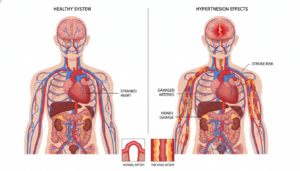
Arterial Damage and Atherosclerosis
Healthy arteries are flexible, smooth, and elastic.
They expand and contract efficiently with every heartbeat.
When high blood pressure batters artery walls repeatedly the smooth inner lining becomes damaged.
Inflammatory cells and cholesterol begin to accumulate at the sites of damage — forming plaques that narrow and harden the arteries.
This process is called atherosclerosis, and it dramatically increases the risk of heart attack and stroke.
As arteries narrow and stiffen the heart must work harder to push blood through them.
The heart muscle thickens in response to this increased workload — a condition called left ventricular hypertrophy.
Over time this thickening weakens the heart and increases the risk of heart failure.
Kidney Damage
The kidneys filter approximately 200 liters of blood every single day through a dense network of tiny blood vessels.
High blood pressure damages these delicate vessels — gradually reducing the kidneys’ ability to filter waste from the blood.
Over years of uncontrolled hypertension the kidneys progressively lose function.
Hypertension is the second leading cause of kidney failure in the United States.
Brain Damage and Stroke Risk
The brain is extraordinarily sensitive to changes in blood flow and blood pressure.
High blood pressure damages the blood vessels that supply the brain — increasing the risk of both ischemic stroke from blood clots and hemorrhagic stroke from ruptured blood vessels.
Research also links long-term hypertension to accelerated cognitive decline and dementia.
The Blood Sugar Connection
Here is something that most people do not know about high blood pressure — and it fundamentally changes how the problem needs to be addressed.
High blood pressure and elevated blood sugar are deeply interconnected.
They share the same root causes — insulin resistance, inflammation, poor metabolic function — and they damage the body through the same mechanisms.
People with high blood pressure are significantly more likely to have insulin resistance and elevated blood sugar.
And people with Type 2 Diabetes are significantly more likely to have high blood pressure.
They are not separate conditions.
They are expressions of the same underlying metabolic dysfunction.
Addressing one without addressing the other always produces incomplete results.
Why Conventional Blood Pressure Treatments Are Not the Complete Answer
Most Americans with high blood pressure are managed with prescription medications — ACE inhibitors, beta blockers, calcium channel blockers, or diuretics.
These medications can reduce blood pressure numbers. But they come with significant limitations and risks that are rarely discussed openly.
Statins — commonly prescribed alongside blood pressure medications for high cholesterol — carry their own serious concern.
Research published by Oxford University found that statins can cause a small but meaningful increase in blood sugar levels.
This means that the very medication prescribed to reduce cardiovascular risk may be worsening the blood sugar problem that is contributing to cardiovascular damage.
Patients who are already at high risk for diabetes may develop the condition sooner as a direct result of statin use.
GLP-1 medications like Ozempic and Wegovy
— increasingly prescribed for blood sugar and weight management
— have been associated with a significantly elevated risk of stomach paralysis (gastroparesis) as reported in multiple peer-reviewed studies and major health publications.
Blood pressure medications do not repair the arterial damage that hypertension has already caused.
They do not address insulin resistance.
They do not improve the metabolic dysfunction that is driving both high blood pressure and elevated blood sugar simultaneously.
And they require lifelong use with ongoing monitoring and dose adjustment.
This does not mean medication is never appropriate.
For people with severely elevated blood pressure medication may be a necessary and life-saving intervention.
But for the millions of Americans with moderate hypertension who also have elevated blood sugar, insulin resistance, and metabolic dysfunction there is a compelling case for addressing the root causes naturally.
The 5 Warning Signs Your Blood Pressure Is Already Dangerously High
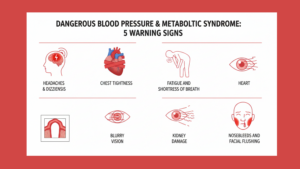
Because high blood pressure is so often asymptomatic the warning signs that do appear typically indicate that blood pressure has already reached seriously elevated levels. Take these seriously.
- Persistent Headaches Especially in the Morning
Severe or persistent headaches — particularly upon waking — are a classic warning sign of significantly elevated blood pressure. High blood pressure causes increased pressure in the blood vessels of the brain, which can produce intense headaches that are different in character from tension or stress headaches.
- Dizziness and Lightheadedness
Dizziness, particularly when standing up quickly, or a persistent sense of lightheadedness can indicate that blood pressure fluctuations are affecting blood flow to the brain. This symptom should always be evaluated.
- Chest Tightness or Palpitations
Any sensation of tightness, pressure, or discomfort in the chest — or irregular heartbeat palpitations — in the context of known or suspected high blood pressure requires immediate medical attention. These symptoms can indicate that the heart is already under significant strain.
- Blurry Vision or Visual Disturbances
The small blood vessels in the eyes are highly sensitive to blood pressure changes. Blurry vision or visual disturbances can indicate that hypertension is affecting the blood vessels of the retina — a condition called hypertensive retinopathy that can cause permanent vision damage if untreated.
- Facial Flushing and Nosebleeds
While these symptoms have many potential causes, frequent nosebleeds and facial flushing in the context of elevated blood pressure are worth taking seriously.
They can indicate that blood pressure has risen to levels that are stressing the small blood vessels of the face and nasal passages.
The Triple Threat: Blood Pressure, Blood Sugar, and Weight
The most important insight in modern cardiovascular health is that high blood pressure, elevated blood sugar, and excess weight are not three separate problems requiring three separate treatments.
They are three expressions of the same underlying condition — metabolic dysfunction driven by insulin resistance, chronic inflammation, and poor lipid metabolism.
Addressing only one of these three while ignoring the others is why so many people take blood pressure medication for years without significantly reducing their cardiovascular risk.
The medication lowers the blood pressure number.
But the insulin resistance continues.
The inflammation continues.
The damage to blood vessels continues through different mechanisms.
The most effective approach addresses all three simultaneously.
Reducing blood pressure.
Managing blood sugar and reversing insulin resistance.
Improving cholesterol ratios — lowering LDL and raising HDL.
Reducing the excess weight that drives all three conditions.
When these interconnected problems are addressed together through a comprehensive natural formula the results go far beyond what targeting any single factor alone can achieve.
In our next article we review GlucoTru Pro
— a triple action formula specifically designed to regulate blood pressure, manage blood sugar and reverse insulin resistance, and support healthy weight loss
— all simultaneously with 100 percent natural clinically proven ingredients.
Click here to read the full GlucoTru Pro review and discover the natural triple action solution for blood pressure, blood sugar, and weight
Your cardiovascular health cannot wait.
Every year of uncontrolled blood pressure and blood sugar is another year of silent damage.
Take action today.
Disclaimer: This article is for informational and educational purposes only. It is not intended to diagnose, treat, cure, or prevent any disease. Always consult with a qualified healthcare professional before starting any new supplement or making changes to your treatment approach.
Leave a Reply