
Why Back and Nerve Pain Gets Worse After 50: The Real Cause Doctors Most Miss

Back and nerve pain after 50 is not just a normal part of aging — and if you are living with worsening sciatica, shooting leg pain, or chronic lower back pain that no treatment seems to fix, there is a biological reason it keeps getting worse.
The pain is real.
The progression is real.
And the cause has very little to do with how much you rest, how many painkillers you take, or even how many physical therapy sessions you attend.
There is a specific explanation for why back and nerve pain accelerates after midlife — and most conventional approaches never address it.
In this article, we break down exactly what is happening inside your body after 50, why standard treatments fall short, and what the latest research says about addressing the real root cause.
The Moment Everything Changed: Why Pain Gets Harder to Ignore After 50
Most people over 50 can identify a turning point.
There was a time when back pain was occasional — a twinge after lifting something heavy, a stiff morning that resolved by noon.
And then, somewhere along the way, the pain became a constant companion.
Morning stiffness that takes an hour to work through. A shooting sensation down the leg that appears without warning.
A deep, burning ache in the lower back that ibuprofen barely touches anymore.
What changed?
The answer is not simply that you got older. Aging alone does not explain the acceleration.
What explains it is a specific set of biological changes that converge after 50 — changes that most pain management approaches are not designed to address.
“For adults dealing with back and nerve pain after 50, this cycle becomes increasingly difficult to break…”
The 3 Biological Changes Driving Worsening Back and Nerve Pain After 50
1. The Collapse of the Spinal Disc Cushioning System
Your spinal discs are the shock absorbers of your spine.
Each disc is composed largely of water — and that water content is what gives the disc its ability to absorb impact, distribute pressure evenly, and maintain the space between vertebrae that keeps nerves from being compressed.
After 50, disc hydration declines significantly.
The cells responsible for maintaining disc tissue — called nucleus pulposus cells — become less efficient at retaining water and regenerating disc matrix.
The result is disc thinning and dehydration that happens gradually, almost invisibly, until one day the disc is compressed enough to begin pressing on a nearby nerve.
This is the mechanical origin of most sciatic nerve pain in adults over 50.
Back and Nerve Pain After 50
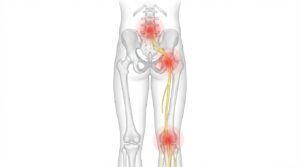
When a dehydrated, thinned disc bulges or herniates, it can compress the sciatic nerve
— the longest nerve in the human body, running from the lower spine through the buttocks and down each leg.
That compression produces the characteristic shooting pain, numbness, and tingling that millions of people over 50 experience daily.
And because disc dehydration is a progressive process, the compression tends to worsen over time without intervention.
2. The Chronic Inflammation Cycle That Will Not Switch Off
Inflammation is not inherently a problem.
Acute inflammation is how the body heals — it floods an injured area with immune cells, clears damaged tissue, and rebuilds.
The problem after 50 is that inflammation stops being acute and starts being chronic.
Researchers refer to this phenomenon as inflammaging
— a portmanteau of inflammation and aging that describes the low-grade, persistent inflammatory state that characterizes the biology of midlife and beyond.
In the context of back and nerve pain, chronic inflammation has two devastating effects.
First, it directly sensitizes nerve tissue.
Inflammatory molecules called cytokines — particularly TNF-alpha, IL-1, and IL-6
— have been shown to lower the pain threshold of nerve fibers, making them fire pain signals more easily and more intensely.
This is why nerve pain after 50 often feels disproportionate to the structural damage visible on imaging.
The nerves themselves have been chemically sensitized by years of low-grade inflammation.
Second, chronic inflammation accelerates the very disc degeneration described above.
Inflammatory cytokines degrade the collagen matrix of spinal discs, accelerating thinning and reducing the disc’s ability to retain water.
It is a vicious cycle — disc degeneration triggers inflammation, and inflammation accelerates disc degeneration.
3. The Decline of the Body’s Natural Nerve Repair Mechanisms
The nervous system has a remarkable — though often underappreciated — capacity for self-repair.
Nerve Growth Factor (NGF) and Brain-Derived Neurotrophic Factor (BDNF) are proteins that support the survival, maintenance, and regeneration of nerve tissue.
They essentially act as the maintenance crew for your nervous system, repairing damaged nerve fibers and maintaining the myelin sheath
— the protective coating around nerves that allows them to transmit signals efficiently.
Back and Nerve Pain After 50
After 50, production of both NGF and BDNF declines significantly.
At the same time, the body’s production of antioxidant enzymes — which protect nerve tissue from oxidative damage — also decreases.
The result is that nerve tissue becomes more vulnerable to damage just as the body’s capacity to repair that damage is diminishing.
This explains why nerve pain that began as occasional shooting sensations can evolve into constant burning, numbness, or weakness over time.
The nerves are accumulating damage faster than they can repair it.
Why Conventional Back Pain Treatments Fall Short After 50
Back and Nerve Pain After 50
Understanding the three biological mechanisms above makes it immediately clear why most conventional pain management approaches produce limited long-term results for adults over 50.
Pain Medications Address the Signal, Not the Source
Anti-inflammatory medications — both over-the-counter NSAIDs and prescription options — work by blocking the production of inflammatory molecules.
They reduce the pain signal.
According to the <a href=”https://www.ncbi.nlm.nih.gov”target=”_blank”>National Library of Medicine</a>,chronic neuroinflammation is a primary driver of
progressive nerve pain in adults over 50.
But they do not stop the underlying disc degeneration.
They do not restore nerve growth factor production.
They do not address the chronic inflammaging that is sensitizing nerve tissue at the cellular level.
When the medication wears off, the biological processes driving the pain continue uninterrupted.
Long-term NSAID use also carries significant risks for adults over 50
— including gastrointestinal damage, cardiovascular effects, and kidney stress
— making them an unsustainable solution for a chronic, progressive condition.
Physical Therapy Helps — But Has Clear Limits
Physical therapy is genuinely valuable for back and nerve pain.
Targeted exercises can improve spinal stability, reduce pressure on compressed discs, and maintain mobility.
But physical therapy cannot rehydrate dehydrated discs.
It cannot reverse the chronic inflammatory state that is sensitizing nerve tissue.
And it cannot compensate for the decline in nerve growth factors that leaves nerve tissue increasingly vulnerable to damage.
For many adults over 50, physical therapy provides meaningful but partial relief — enough to improve function, but not enough to stop the progression.
Injections Provide Temporary Windows, Not Lasting Solutions
Corticosteroid injections — commonly used for sciatica and nerve compression — can provide significant short-term relief by reducing local inflammation around the compressed nerve.
But the relief is temporary by design.
The injection does not address the structural cause of compression.
It does not restore disc height.
And repeated injections carry their own risks, including potential acceleration of tissue breakdown with frequent use.
For many patients, injections become a management strategy that buys time between flare-ups rather than a path toward lasting resolution.
Back and Nerve Pain After 50
What the Research Actually Says About Addressing the Root Cause
The growing body of research on nerve pain, spinal degeneration, and chronic inflammation after 50 points toward a fundamentally different approach — one focused on addressing the underlying biological mechanisms rather than managing symptoms.
Targeting Neuroinflammation at the Cellular Level
Research published in peer-reviewed journals has identified several naturally occurring compounds with the ability to modulate neuroinflammation
— specifically targeting the TNF-alpha and IL-1 pathways that sensitize nerve tissue and accelerate disc degeneration.
Unlike systemic anti-inflammatory drugs, which suppress inflammation broadly throughout the body, these compounds appear to work selectively on the neural and spinal tissue most affected by the inflammatory cascade.
Supporting the Myelin Sheath and Nerve Regeneration
The myelin sheath — the protective coating around nerve fibers — is critical to nerve signal transmission and pain regulation.
Research has identified specific B vitamins, particularly B1 (thiamine), B6 (pyridoxine), and B12 (cobalamin), as essential cofactors in myelin synthesis and nerve regeneration.
Deficiencies in these vitamins
— which become increasingly common after 50 due to reduced absorption efficiency
— are directly linked to increased nerve pain, slower nerve repair, and heightened vulnerability to compression damage.
Addressing the Mechanical Component — Collagen and Disc Support
Research on collagen type II, glucosamine, and specific plant-derived compounds has demonstrated the ability to support disc matrix integrity
— helping to maintain the structural components that resist further degeneration.
While these approaches cannot reverse advanced disc damage, early and consistent intervention has been shown to slow progression and support the disc’s residual capacity for self-maintenance.
The Warning Signs That Your Nerve Pain Is Progressing

Because nerve pain after 50 tends to worsen gradually, many people adapt to increasing levels of discomfort without recognizing the progression.
“Recognizing that back and nerve pain after 50 follows a predictable biological progression is critical…”
These are the signs that the underlying biological process is advancing:
Expanding pain territory.
If sciatic pain that once stopped at the knee is now reaching the foot, or if one-sided back pain has become bilateral, the nerve compression is likely worsening.
Increasing frequency of flare-ups.
If episodes that once occurred monthly are now happening weekly, the threshold for triggering pain is decreasing — a sign of progressive nerve sensitization.
Numbness replacing sharp pain.
When burning or shooting pain transitions to numbness or weakness in the leg or foot, it may indicate that nerve fiber damage has advanced beyond simple compression.
Morning stiffness lasting longer than 30 minutes.
Extended morning stiffness is a consistent indicator of overnight disc compression and inflammatory activity that the body is struggling to resolve.
Reduced response to previously effective treatments.
When pain relievers or physical therapy produce less relief than they once did, it typically means the underlying biological drivers have progressed beyond what symptomatic treatment can adequately address.
If you recognize three or more of these patterns, the evidence strongly suggests that the standard approach of managing symptoms is not sufficient — and that addressing the root biological mechanisms has become urgent.
A Different Approach: What Comprehensive Nerve and Back Pain Support Looks Like
The research points toward a multi-mechanism approach that simultaneously addresses the three biological drivers identified above
— neuroinflammation, nerve tissue vulnerability, and structural disc support.
This means combining targeted anti-inflammatory support at the cellular level, nutrients that support nerve regeneration and myelin integrity, and compounds that help maintain disc structure and hydration.
“Managing back and nerve pain after 50 requires addressing the root cause…”
It also means consistency.
Because the biological processes driving nerve pain after 50 are continuous and progressive, effective support needs to be consistent
— not episodic like pain medication, but ongoing like the biological processes it is designed to counterbalance.
The Bottom Line
Back and nerve pain after 50 is not an inevitable consequence of aging that must simply be endured.
It is the result of specific, identifiable biological mechanisms
— disc dehydration and degeneration, chronic neuroinflammation, and declining nerve repair capacity
— that conventional pain management is not designed to address.
Understanding these mechanisms is the first step toward a genuinely different approach.
One that does not simply mask the pain signal but works at the level where the pain originates.
The Natural Formula Designed to Address All Three Root Causes
After understanding the three biological mechanisms driving back and nerve pain after 50
— disc degeneration, chronic neuroinflammation, and declining nerve repair capacity — the
next question is obvious: is there a natural solution that addresses all three simultaneously?
That is exactly what we investigated next.
If you’ve been struggling with constant discomfort, tingling, or sharp pain that seems to radiate through your lower back and legs, it’s time to look beyond temporary fixes.
Why Back and Nerve Pain Gets Worse After 50: The Real Cause Doctors Most Miss often has less to do with muscles and more to do with how your nerves are being affected over time. Ignoring this can allow the problem to quietly worsen, limiting your mobility and quality of life.
That’s why many people are turning to solutions like NervEase, designed to support nerve health and target discomfort at its source instead of just masking symptoms.
👉 If you want to finally address the root cause and experience real relief, now is the moment to take action.
👉 Click below to learn how NervEase is helping people over 50 regain comfort, mobility, and control over their daily lives.
Disclaimer: This article is for informational and educational purposes only and does not constitute medical advice. The information presented is based on available research and is intended to support general health education. It is not intended to diagnose, treat, cure, or prevent any disease or medical condition. Individual results vary. Always consult with a qualified healthcare professional before starting any supplement or making changes to your current health regimen.
Leave a Reply