
Why Your Brain Slows Down Brain Fog After 50: The Brain Fog Crisis

Brain fog after 50 is one of the most common — and most dismissed — health complaints affecting adults in the United States today.
You walk into a room and forget why you went there.
You reach for a name that is right on the tip of your tongue and it refuses to come.
You sit down to focus on something important and your mind wanders after five minutes.
You hit a wall of mental exhaustion by mid-afternoon that no amount of coffee can fix.
And you tell yourself the same thing millions of other people tell themselves.
This is just getting older.
This is normal.
There is nothing I can do about it.
But here is what the latest neuroscience research reveals.
Brain Fog After 50
The brain fog, memory lapses, and mental fatigue you are experiencing after 50 are not an inevitable part of aging that you simply have to accept.
They are symptoms — symptoms of a brain that is not getting the biological support it needs to function at its best.
And that is something you absolutely can do something about.
In this article you are going to discover exactly what causes the brain to slow down after 50, why the consequences of ignoring it go far beyond occasional forgetfulness, the five warning signs that your brain is already in decline, and what the latest cognitive science says about reversing it naturally.
What Actually Causes Brain Fog After 50?
To understand why the brain slows down as we age, you first need to understand how the brain actually works — and what changes as we get older.
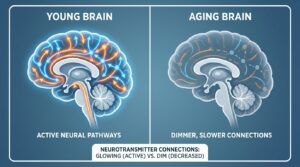
Your brain contains approximately 86 billion neurons — nerve cells that communicate with each other through chemical messengers called neurotransmitters.
When your brain is functioning optimally these neurons fire rapidly and efficiently, transmitting signals across billions of neural connections at lightning speed.
The result is sharp focus, clear thinking, reliable memory, and the mental energy to perform at your best.
But after age 50 several critical changes begin to occur simultaneously.
Neurotransmitter Production Declines
Acetylcholine — the neurotransmitter most critical for memory formation and recall — declines significantly with age.
Dopamine — which drives motivation, focus, and mental energy — also decreases.
Serotonin levels shift, affecting mood stability and mental clarity.
When these neurotransmitters decline, the brain literally cannot communicate as efficiently as it used to.
Messages take longer to transmit.
Brain Fog After 50
Information takes longer to process. Memory becomes less reliable.
Focus becomes harder to sustain.
Blood Flow to the Brain Decreases
Your brain represents only about 2 percent of your body weight but consumes roughly 20 percent of your total blood flow and oxygen supply.
As we age, cardiovascular changes reduce the efficiency of blood delivery to the brain.
Less blood flow means less oxygen and fewer nutrients reaching the neurons that need them to function.
The result is the mental fatigue, brain fog, and slowed thinking that so many adults over 50 experience.
Brain Cell Walls Weaken
Every neuron in your brain is surrounded by a protective membrane — the cell wall — that regulates what enters and exits the cell.
As we age, these cell walls become less fluid and less permeable.
Nutrients have a harder time getting into brain cells.
Waste products have a harder time getting out.
This cellular deterioration contributes directly to declining cognitive performance.
Inflammation Increases
Chronic low-grade neuroinflammation — inflammation inside the brain — increases with age and is now recognized as one of the primary drivers of cognitive decline.
This neuroinflammation damages neural connections, disrupts neurotransmitter production, and accelerates the degeneration of brain cells.
Research increasingly links chronic neuroinflammation to not just brain fog and memory problems but to more serious conditions including Alzheimer’s disease and other forms of dementia.
The Real Consequences of Ignoring Brain Fog
Most people dismiss brain fog and mild memory problems as harmless inconveniences.
That is a dangerous mistake.
Research from leading neuroscience institutions including Harvard Medical School has established that the cognitive changes people experience in their 50s and 60s are not just annoying
— they are predictive.
The degree of cognitive decline a person experiences in midlife is strongly associated with their risk of developing serious neurodegenerative conditions including Alzheimer’s disease and vascular dementia later in life.
In other words, the brain fog you are dismissing today as minor and manageable may be the early warning signal of something far more serious developing over the coming years.
Beyond the long-term risk, the day-to-day consequences of untreated cognitive decline are significant.
Professional Performance Suffers
Brain Fog After 50
The ability to focus deeply, process information quickly, retain and recall details, and make sharp decisions under pressure
— these are the cognitive capabilities that professional success depends on.
When brain fog sets in, all of these capabilities erode.
Work that used to feel manageable becomes exhausting.
Decisions that used to come easily now require significantly more mental effort.
The confidence that comes from feeling mentally sharp begins to fade.
Relationships Are Affected
Forgetting names, missing appointments, losing track of conversations, and struggling to stay mentally present — these lapses affect relationships in ways that go beyond simple inconvenience. They create frustration, erode confidence, and can make social interactions feel stressful rather than enjoyable.
Quality of Life Declines
Mental sharpness is fundamental to the enjoyment of life.
Reading, learning new things, engaging in stimulating conversations, solving problems, pursuing goals — all of these activities depend on a brain that is functioning at its best.
When cognitive decline takes hold, life becomes smaller and less engaging.
The 5 Warning Signs Your Brain Is Already In Decline
Because cognitive decline is gradual, most people dismiss the early signs for years before acknowledging there is a real problem.
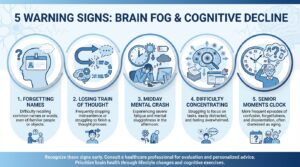
Here are the five most common warning signs that your brain needs support:
- You Frequently Forget Names, Words, or Appointments
If you find yourself regularly forgetting the names of people you know, struggling to find words mid-sentence, or missing appointments and commitments, your memory formation and recall systems are already compromised.
This is one of the earliest and most common signs of age-related cognitive decline.
- You Lose Your Train of Thought Mid-Conversation or Mid-Task
If you frequently start a sentence and forget where you were going, or begin a task and lose track of what you were doing, your working memory — the system that holds information in mind while you use it — is declining.
This is a classic symptom of reduced acetylcholine activity and weakening neural connections.
- You Experience a Significant Mental Energy Crash by Midday
If your mental energy peaks in the morning and then falls off a cliff by early afternoon, leaving you foggy, unfocused, and reliant on caffeine to get through the rest of the day, your brain is not efficiently producing or utilizing the energy it needs.
This midday cognitive crash is one of the most consistent complaints of adults experiencing age-related cognitive decline.
- You Struggle to Focus on One Thing For More Than a Few Minutes
If sustained concentration has become difficult — if your mind wanders constantly during reading, meetings, or conversations — your attention and focus systems are weakening.
In a healthy brain, focusing is effortless.
When the neurotransmitters that support attention decline, maintaining focus requires conscious effort and becomes increasingly difficult.
- You Experience Frequent Senior Moments That Are Getting Worse
Walking into rooms and forgetting why.
Putting things in unusual places.
Repeating yourself in conversations.
Starting tasks and forgetting to finish them.
These senior moments are easy to laugh off in isolation — but if they are happening regularly and getting more frequent, they are a serious signal that your brain needs support now.
What Most People Get Wrong About Brain Health After 50
There is a pervasive myth that cognitive decline is simply inevitable — that there is nothing you can do to stop your brain from slowing down as you age.
That myth is not supported by modern neuroscience.
The brain has a property called neuroplasticity — the ability to form new neural connections, adapt to challenges, and in some cases recover function that has been lost.
Research has demonstrated that the right combination of lifestyle factors and targeted nutritional support can significantly slow cognitive decline, improve memory and focus, and restore mental clarity even in adults who have been experiencing brain fog for years.
Brain Fog After 50
The key is providing the brain with what it needs to support neurotransmitter production, increase blood flow and oxygenation, protect neurons from damage, and stimulate the growth of new neural connections.
Read the ZenCortex Review article.
Specific natural compounds — adaptogens, amino acids, and essential nutrients — have been clinically shown to support these exact processes.
Compounds like phosphatidylserine, bacopa monnieri, lion’s mane mushroom, and ginkgo biloba have decades of peer-reviewed research showing their ability to support memory, focus, mental energy, and overall brain health in aging adults.
The Bottom Line: Brain Fog Is a Warning — Not a Sentence
If you recognized yourself in the five warning signs above, please do not dismiss what your brain is telling you.
See the TurboReviews channel playlist
Brain fog and cognitive decline are not just inconveniences to be managed with more coffee or more sleep.
They are signals that your brain is not getting the biological support it needs — and that the window to do something meaningful about it is right now.
The good news is that targeted cognitive support exists. Natural nootropic formulas combining the most clinically studied brain-supporting compounds can restore mental clarity, improve memory and focus, and give your brain the fuel it needs to perform at its best — at any age.
“But what most people don’t realize is that brain fog after 50 isn’t always just about memory or aging…
In many cases, it’s connected to how your brain processes sound.
As we get older, the auditory system becomes less efficient.
The brain has to work harder to interpret sounds, filter noise, and maintain focus.
Brain Fog After 50
And that constant overload can silently drain your mental energy — leading to:
- poor concentration
- mental fatigue
- that “foggy” feeling that won’t go away
That’s why some researchers now believe that supporting the connection between hearing and brain function may be one of the missing pieces.
Recently, I came across a natural formula designed specifically to support this brain-hearing connection.
It’s not a quick fix — but for people dealing with constant mental fatigue, it may help support clearer thinking by reducing the hidden load on the brain.”
Click here to read the full review and discover the natural solution to brain fog and cognitive decline
Your brain is not finished. It just needs the right support. Take action today.
Disclaimer: This article is for informational and educational purposes only. It is not intended to diagnose, treat, cure, or prevent any disease. Always consult with a qualified healthcare professional before starting any new supplement.