
Why You Can’t Lose Weight After 40: Thermogenic Resistance

Thermogenic resistance is the hidden metabolic block that prevents your body from burning fat—even when you’re eating less and exercising more.
If you’re over 40 and the weight won’t budge no matter what you try, this is the reason why.
You’re doing everything right. You’ve cut calories. You’re walking every day. You’ve given up sugar, bread, and late-night snacks.
And yet—nothing. The scale doesn’t move. The clothes don’t fit better. The belly fat stays exactly where it is.
Meanwhile, you’re exhausted. Your hands and feet are cold all the time.
You’re craving food you know you shouldn’t eat.
And the worst part?
You feel like you’re failing—when the truth is, your body is working against you in ways you never even knew were possible.
If this sounds familiar, you’re not alone. And more importantly—it’s not your fault.
What you’re experiencing has a name. It’s called thermogenic resistance.
And it’s one of the most frustrating, least-talked-about reasons why people over 40 can’t lose weight no matter how hard they try.
What Is Thermogenic Resistance—And Why Does It Make Weight Loss Impossible?
To understand thermogenic resistance, you first need to understand what thermogenesis actually is.
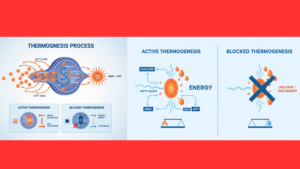
Thermogenesis is your body’s natural process of burning calories to produce heat and energy.
It’s happening all the time—when you’re eating, when you’re moving, when you’re sitting still, even when you’re sleeping.
In a healthy metabolism, thermogenesis keeps your energy levels stable and allows your body to burn stored fat for fuel when you’re not eating.
But after a certain age—especially after 35 or 40—something changes.
Your body starts developing resistance to this process. The fat-burning system that used to work automatically starts to slow down.
And eventually, it stops working altogether.
This is thermogenic resistance. And when it sets in, your body loses its ability to enter the natural fat-burning state it was designed to use.
The result? You can eat less, exercise more, and do everything “right”—and still gain weight. Because your metabolism isn’t responding the way it’s supposed to.
The Science: What Actually Happens Inside Your Body

Research from Harvard, the Mayo Clinic, and the University of Barcelona has confirmed what millions of people already suspected:
metabolism slows dramatically after age 35—and it’s not just about getting older.
Here’s what’s really happening:
1. Your Body’s Energy Expenditure Drops—Even When You Haven’t Lost Muscle
One of the most groundbreaking discoveries in recent metabolic research is something called adaptive thermogenesis.
This is when your resting energy expenditure (the calories you burn just by being alive) drops below what it should be based on your body composition.
In plain English: your body starts burning fewer calories than it’s supposed to—even if you haven’t lost muscle mass.
Studies show that after weight loss, some people’s metabolism drops by 200 to 400 calories per day more than expected.
That means even if you’re eating a “normal” amount of food, your body is treating it like a surplus and storing it as fat.
And here’s the worst part: this metabolic slowdown can persist for years.
Research on participants from “The Biggest Loser” TV show found that six years after losing weight, their metabolism was still suppressed by an average of 500 calories per day.
Their bodies never recovered.
2. Fat Cells Become Resistant to Releasing Stored Energy
When thermogenic resistance sets in, your fat cells don’t just store fat—they hold onto it. Even when you’re in a calorie deficit.
Even when you’re exercising. Even when you’re doing everything you’re supposed to do.
This happens because the hormonal signals that tell fat cells to release energy stop working properly.
Insulin resistance, leptin resistance, and reduced thyroid function all contribute to a metabolism that’s essentially locked in “storage mode.”
Your body interprets the calorie deficit as a threat.
And instead of burning fat for fuel, it conserves every ounce it can.
3. Hormonal Changes Accelerate the Problem (Especially for Women)
For women, the hormonal shifts that happen during perimenopause and menopause make thermogenic resistance even worse.
Estrogen plays a critical role in regulating where your body stores fat and how efficiently it burns calories.
When estrogen levels drop, fat storage shifts to the midsection—and the body’s ability to burn that fat decreases dramatically.
At the same time, cortisol (the stress hormone) tends to rise with age.
Elevated cortisol promotes fat storage around the belly and suppresses the metabolic processes that would normally keep weight in check.
The combination of falling estrogen and rising cortisol creates the perfect storm for stubborn, unshakable weight gain.
4. The Thyroid Slows Down—And Takes Your Metabolism With It
Your thyroid gland controls your metabolic rate.
When thyroid function declines—which happens naturally with age, stress, and hormonal changes—your entire metabolism slows down.
Even if your thyroid levels are technically “normal” on a blood test, they may still be too low to support healthy thermogenesis.
This is called subclinical hypothyroidism, and it affects millions of people who have no idea it’s happening.
The result is chronic fatigue, cold sensitivity, brain fog, and—of course—weight that won’t budge no matter what you do.
Why Traditional Diet and Exercise Don’t Work When You Have Thermogenic Resistance
If you’ve been trying to lose weight by eating less and moving more, you’ve probably noticed that it doesn’t work the way it used to.
Here’s why:
Eating less makes the problem worse. When you drastically cut calories, your body interprets it as starvation.
Your metabolism slows down even further to conserve energy.
You might lose a few pounds initially, but within weeks, the weight loss stalls—and often reverses.
Exercise alone can’t overcome a broken metabolism.
Yes, exercise burns calories in the moment.
But if your resting metabolic rate is suppressed by 300 to 500 calories per day due to thermogenic resistance, the 200 calories you burned on a treadmill aren’t going to make a dent.
Your body fights back harder the more you restrict.
The more aggressively you diet, the more your body doubles down on fat storage.
This is called metabolic adaptation, and it’s one of the main reasons why over 80% of people who lose weight gain it all back within a year.
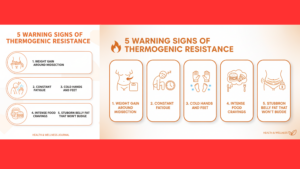
The 5 Warning Signs You’re Dealing With Thermogenic Resistance
Not sure if thermogenic resistance is affecting you? Here are the telltale signs:
1. You Gain Weight Around Your Midsection—Even When You’re Eating Less
If fat is accumulating around your belly and waist despite cutting calories, your metabolism has shifted into storage mode.
This is one of the clearest signs of thermogenic resistance.
2. You Feel Exhausted All the Time—No Matter How Much You Sleep
When your body can’t convert food into usable energy efficiently, fatigue becomes a constant.
You might sleep 8 hours and still wake up feeling drained.
3. Your Hands and Feet Are Always Cold
Low thermogenesis means your body isn’t producing enough heat.
Cold extremities are a classic sign that your metabolic fire has gone out.
4. You Experience Intense Food Cravings—Especially for Carbs and Sugar
When your body isn’t burning fat for energy, it desperately seeks quick fuel.
This shows up as uncontrollable cravings for bread, pasta, sweets, and other high-carb foods.
5. The Scale Won’t Move—No Matter What You Try
If you’ve been dieting for weeks or months with zero results, thermogenic resistance is almost certainly the culprit.
Your body has adapted to defend its current weight, and traditional approaches can’t break through.
What Actually Works: Reigniting Thermogenesis at the Source
The good news is that thermogenic resistance isn’t permanent.
With the right approach, you can restore your body’s ability to burn fat naturally.
But it’s not about eating less or exercising more.
It’s about targeting the biological mechanisms that control thermogenesis in the first place.
Here’s what science shows actually works:
1. Support Mitochondrial Function
Your mitochondria are the energy powerhouses of your cells.
When they’re working properly, they burn fat efficiently.
When they’re sluggish, thermogenesis shuts down.
Certain natural compounds—like those found in green tea, ginger, and red pepper—have been shown to activate mitochondrial function and increase calorie burning by up to 25% after meals.
2. Activate the Sympathetic Nervous System Naturally
The sympathetic nervous system controls your body’s “fight or flight” response—and it’s also responsible for triggering fat-burning thermogenesis.
Compounds like p-synephrine, found naturally in Seville orange peel, have been shown in multiple studies to increase thermogenesis by up to 74% without raising heart rate or blood pressure. This makes it one of the most powerful natural thermogenic activators available.
3. Improve Insulin Sensitivity and Blood Sugar Control
When your body is insulin resistant, it can’t access stored fat for energy.
Improving insulin sensitivity is critical for breaking through thermogenic resistance.
Ingredients like berberine and apple cider vinegar have been shown to improve how your cells respond to insulin, which allows your body to start burning fat again instead of storing it.
4. Balance Hormones That Control Fat Storage
Restoring healthy levels of thyroid hormones, balancing cortisol, and supporting estrogen metabolism are all essential for overcoming thermogenic resistance—especially for women over 40.
Adaptogens like Korean Red Ginseng and metabolic supporters like Himalayan Ginger help regulate these hormones naturally, giving your body the internal environment it needs to burn fat efficiently.
The Bottom Line: Your Metabolism Isn’t Broken Forever
If you’ve been blaming yourself for weight that won’t budge, it’s time to stop.
Thermogenic resistance is a real, biological condition—and it’s the reason why so many people over 40 struggle with weight loss despite doing everything “right.”
The good news is that once you understand what’s actually happening inside your body, you can start addressing the root cause instead of fighting a losing battle with calorie restriction and endless cardio.
Your metabolism didn’t break because you failed.
It adapted because your body is trying to protect you from what it perceives as starvation.
The key is retraining your metabolism to burn fat naturally again—and that starts with reigniting thermogenesis at the cellular level.
Ready to Break Through Thermogenic Resistance?
If everything in this article resonates with you—the stubborn weight, the constant fatigue, the feeling that your body has completely turned against you—there’s a natural solution designed specifically to target thermogenic resistance.
CitrusBurn is a breakthrough supplement formulated with 7 clinically-studied natural ingredients that work together to restore your body’s ability to burn fat naturally.
Each ingredient was chosen for one specific purpose:
to reignite thermogenesis and break through metabolic resistance.
✅ Seville Orange Peel (p-synephrine) — Increases thermogenesis by up to 74% without stimulants
✅ Spanish Apple Vinegar — Improves insulin sensitivity and promotes satiety
✅ Andalusian Red Pepper — Boosts calorie burn by 25% after meals
✅ Himalayan Ginger — Reduces cravings by 54% and supports blood sugar balance
✅ Ceremonial Green Tea — Enhances fat oxidation and energy production
✅ Berberine & Korean Red Ginseng — Restore metabolic and hormonal balance
CitrusBurn™ works with your body—not against it. It’s not a harsh stimulant.
It’s not a crash diet. It’s a science-backed formula designed to restore the natural fat-burning process that thermogenic resistance has shut down.
And here’s the best part: CitrusBurn™ comes with a 180-day money-back guarantee.
That’s six full months to try it risk-free.
If you don’t see results, you get every cent back. No questions asked.
Don’t spend another day fighting a metabolism that’s working against you. Your body wants to burn fat naturally—it just needs the right support to do it again.
Disclaimer: This article is for informational and educational purposes only. It is not intended to diagnose, treat, cure, or prevent any disease. Always consult with a qualified healthcare professional before starting any new supplement or making changes to your health routine.