
Why 48 Million Americans Are Losing Their Hearing And Don’t Know It

Hearing loss after 50 is the most common — and most ignored — health crisis affecting older Americans today.
Over 48 million people in the United States have some degree of hearing loss right now.
And the vast majority of them have no idea how severe the problem has already become.
Here is the uncomfortable truth. Hearing loss is almost never sudden. It does not happen overnight.
It creeps in so gradually — over months and years — that most people dismiss the early signs as minor annoyances.
They turn up the television a little louder. They ask people to repeat themselves a little more often. They blame background noise when they miss words in a conversation.
And by the time they finally admit to themselves that something is wrong, they have already lost a significant portion of their hearing — and spent years disconnecting from the people and sounds that matter most.
In this article you are going to discover exactly how age-related hearing loss works, why it happens, the five warning signs most people dismiss until it is too late, the devastating consequences of leaving it untreated, and what you can do right now to address it without spending thousands of dollars.
What Is Age-Related Hearing Loss And Why Does It Happen?
Age-related hearing loss — known medically as presbycusis — is the gradual loss of hearing that occurs as we get older.
It is one of the most common conditions affecting adults over 50, and it is almost entirely caused by cumulative damage to the tiny hair cells inside your inner ear.
Here is how your hearing actually works.
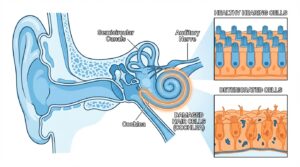
Sound enters your ear canal as vibrations. Those vibrations travel through your eardrum and three tiny bones called the ossicles into your inner ear — a fluid-filled spiral structure called the cochlea. Inside the cochlea are thousands of microscopic hair cells.
These hair cells convert sound vibrations into electrical signals that travel through your auditory nerve to your brain, where they are interpreted as sound.
The problem is that these hair cells are incredibly fragile. And unlike most cells in your body they cannot regenerate. Once they are damaged or destroyed they are gone permanently.
Over decades of exposure to noise, aging, and other factors these hair cells begin to die off. The cells that detect high-frequency sounds — like consonants in speech, birds singing, children’s voices — are typically the first to go. This is why people with early hearing loss often describe sounds as muffled or unclear. They can hear that someone is talking but they cannot make out exactly what is being said.
The Silent Epidemic: Why Most People Wait 7 Years To Get Help
Here is one of the most shocking statistics in audiology. Research shows that the average person waits seven years from the time they first notice hearing problems before seeking help.
Seven years of asking people to repeat themselves. Seven years of missing punchlines, mishearing important information, and nodding along in conversations they could not fully follow. Seven years of slowly withdrawing from social situations because following conversations had become exhausting.
And the reason most people wait so long comes down to two things. First, the gradual nature of hearing loss makes it easy to deny. Because the decline happens so slowly your brain compensates for a long time — working harder to fill in the gaps, relying on lip reading and context clues without you even realizing it. By the time the compensation stops working and you notice the problem clearly, significant damage has already occurred.
Second, the cost of traditional hearing aids — which can range from $2,000 to $5,000 per pair — makes many people avoid addressing the problem altogether. They simply decide to live with it rather than face that kind of expense. And that decision costs them far more than money.
The Devastating Consequences of Untreated Hearing Loss
Most people think untreated hearing loss is just an inconvenience. That is dangerously wrong.
Research from Johns Hopkins University has revealed that hearing loss is one of the most significant risk factors for cognitive decline and dementia. Adults with untreated hearing loss are significantly more likely to develop dementia — with studies showing up to a five times greater risk in those with severe hearing loss compared to those with normal hearing.
Here is why. When your brain has to work harder to process unclear sounds it diverts cognitive resources away from memory and thinking. Over time this cognitive overload accelerates the brain aging process. Additionally the social isolation that comes with untreated hearing loss — avoiding conversations, withdrawing from gatherings, feeling disconnected — further accelerates cognitive decline.
Untreated Hearing Loss and Depression
The connection between hearing loss and depression is well documented. When you can no longer fully participate in conversations, miss out on family gatherings, and feel constantly frustrated by your inability to hear clearly, the emotional toll accumulates rapidly.
Studies show that adults with untreated hearing loss are significantly more likely to experience depression, anxiety, and social isolation than those who address their hearing loss. The world becomes a quieter, more disconnected place — and that isolation takes a serious toll on mental health.
Untreated Hearing Loss and Relationship Damage
Ask anyone whose spouse or parent has untreated hearing loss and they will tell you the same thing. It is exhausting and frustrating for everyone involved.
When conversations require constant repetition, when the television has to be turned up to levels that disturb others, when important information is consistently misheard — relationships suffer. Misunderstandings become more frequent. Frustration builds on both sides. Intimacy decreases as communication becomes more difficult.
Research shows that hearing loss in one partner significantly increases relationship stress and reduces relationship satisfaction for both people involved.
Untreated Hearing Loss and Safety Risks
Being unable to hear clearly is not just a social problem. It is a safety hazard.
Missing a car horn while crossing the street. Not hearing a smoke alarm. Failing to hear someone calling for help. Mishearing instructions from a doctor. These are real, daily risks that people with untreated hearing loss face constantly.
The 5 Warning Signs Your Hearing Is Already Declining
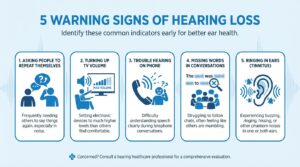
Because hearing loss is so gradual most people dismiss the early signs for years. Here are the five most common warning signs that your hearing has already begun to decline:
1. You Frequently Ask People To Repeat Themselves
If you find yourself saying “what?” or “can you say that again?” multiple times in a typical conversation, your hearing is already declining. This is often the first sign that appears — especially in noisy environments like restaurants or crowded rooms.
2. You Turn The Television Volume Up Higher Than Others Prefer
If family members or guests consistently ask you to turn the TV down, or if you find yourself needing the volume significantly higher than you used to, your hearing threshold has shifted. This is one of the clearest early indicators of hearing loss.
3. You Have Difficulty Following Phone Conversations
Phone calls are particularly challenging for people with hearing loss because you cannot rely on visual cues like lip reading and facial expressions. If phone conversations have become frustrating or difficult to follow, your hearing is already compromised.
4. You Miss Words Or Mishear What People Say
If you frequently think people are saying one thing when they actually said something different — or if speech sounds muffled or unclear even when people are speaking at normal volume — your inner ear hair cells are already damaged.
5. You Hear Ringing, Buzzing, Or Hissing Sounds In Your Ears
Tinnitus — a persistent ringing, buzzing, or hissing sound in the ears — is one of the most common early indicators of hearing damage. While tinnitus has multiple causes, it is frequently a sign that the hair cells in your inner ear have already sustained damage.
Why Traditional Hearing Aids Are Out of Reach For Most Americans
Even when people recognize that their hearing has declined, the path to getting help has historically been filled with obstacles.
Traditional hearing aids require multiple visits to an audiologist for evaluation, fitting, and adjustment. The devices themselves typically cost between $2,000 and $5,000 per pair — and most insurance plans, including Medicare, have historically provided little to no coverage for them.
The result is that the majority of Americans who need hearing help simply go without it. The cost is too high. The process is too complicated. And so they continue to withdraw from social life, strain their relationships, and accelerate their cognitive decline — all because accessible, affordable hearing technology has not been available.
Until now.
The FDA Change That Is Transforming Access To Hearing Technology
In a landmark regulatory change, the FDA now allows Americans to purchase over-the-counter hearing devices without a prescription or audiologist visit. This decision opened the door for a new generation of affordable, high-quality hearing amplifiers that can be purchased directly and delivered to your door.
This regulatory shift has made it possible for millions of Americans who could never afford traditional hearing aids to finally access the hearing technology they need. And the results for those who have taken advantage of this change have been life-changing.
What You Can Do Right Now
If you recognized yourself in any of the five warning signs above, the most important thing you can do is take action now — before the hearing loss progresses further and the consequences for your cognitive health, relationships, and quality of life become more severe.
The good news is that you no longer need to spend thousands of dollars or visit multiple doctors to access quality hearing technology. Over-the-counter hearing amplifiers now offer advanced sound amplification technology at a fraction of the cost of traditional hearing aids — with no prescription required.
In our next article we review a specific solution that is helping thousands of seniors across America hear clearly again for just a dollar a day. The technology is nearly invisible when worn, simple to use, and backed by a 120-day money-back guarantee.
Do not spend another year nodding along in conversations you cannot follow, missing your grandchildren’s voices, or withdrawing from the social life you deserve. Your hearing matters. And now there is an affordable solution to do something about it.
Disclaimer: This article is for informational and educational purposes only. It is not intended to diagnose, treat, cure, or prevent any disease. Always consult with a qualified healthcare professional regarding hearing health concerns.